I extracted some firmwares from ITE Technologies IT9135 Windows driver. There was 3 different firmwares, one for old IT9135AX (ver. 1) and two which seems to be compatible with newer IT9135BX (ver. 2). Windows driver version was 12.10.04. (dated 10/04/2012) - it was the newest driver I was able to find...
dvb-usb-it9135-01.fw - versions: 12.54.14.0 / 2.47.14.0
dvb-usb-it9135-02.fw - versions: 3.42.3.3 / 3.29.3.3
dvb-usb-it9135-02.fw - versions: 3.40.1.0 / 3.17.1.0
dvb-usb-it9135-01.fw firmware seems to be just same old which has been there ages. Each of the dvb-usb-it9135-02.fw were newer, according to version numbers reported by the driver, than the old one around the net (old 3.39.1.0 / 3.9.1.0).
These firmwares are compatible with both Linux AF9035 (dvb_usb_af9035) and IT9135 (dvb_usb_it913x) drivers. AF9035 driver supports IT9135 too.
Feel free to test! Especially I am interested to hear if those new ones behaves differently than older.
Download: http://palosaari.fi/linux/v4l-dvb/firmware/IT9135/
Showing posts with label AF9035. Show all posts
Showing posts with label AF9035. Show all posts
2014-02-09

2013-06-05
Naked hardware #9: TerraTec Cinergy T Stick Dual RC (rev. 2)
TerraTec Cinergy T Stick Dual RC (rev. 2) teardown
That device is ITE Tech IT9135 reference design. It has two independent tuners, so called dual tuner model.TerraTec has assigned USB ID 0ccd:0099 for that device. Unfortunately same USB ID is used for original revision 1 model too, which is build upon AF9015 chipset. AF9015 belongs to same chipset family, but it is two generation older and differs notably. Hey TerraTec guys, don't do that in future, it causes quite a lot headache!
Device is supported under Linux starting from the Kernel 3.10. Linux AF9035 driver supports IT9135/IT9137 too.
TerraTec Cinergy T Stick Dual RC (rev. 2)
 |
| TerraTec Cinergy T Stick Dual RC (rev. 2) |
Key components:
ITE Tech IT9137ITE Tech IT9133
PCB top side
 | ||
| PCB top side |
Black box with 3 pins, partially top of IT9137, is IR-receiver. It is connected to the IT9137, which handles IR decoding. There is also crystal clearly visible. Crystal markings are missing from the reason or the other, but it is most likely 12.000 MHz.
There is two versions of these (IT9130 series) chips available, version 1 and 2. Chips used on that device seems to be version 1. You could see letters AX (v1) or BX (v2) printed top of the chip.
PCB printings: RD168OC VER1.1.
AF9030 and IT9130 family relations
IT9130 family is successor of AF9030 family. Main difference between these families is integrated RF-tuner. IT9130 has integrated RF-tuner whilst external tuner is needed for AF9030. USB-interface and demodulator seems to be quite same between all these chips.IT9137 is same as IT9135 but contains physical pins for connecting slave demodulator (for dual tuner configuration and/or diversity).
These chips are sold as following chip names and integrated combinations:
* AF9032 = demodulator ?
* AF9033 = demodulator
* AF9035 = USB-interface + demodulator
* IT9133 = demodulator + RF-tuner
* IT9135 = USB-interface + demodulator + RF-tuner
* IT9137 = IT9135 + MPEG TS input for connecting slave IT9133
PCB bottom side
 |
| PCB bottom side |
PCB printings: 94-V0, 1213, LJ-M E300053
Missing eeprom
I cannot see serial eeprom anywhere. Device has still TerraTec USB ID, so there must be eeprom somewhere. I suspect it is integrated to the IT9137. I am pretty sure all IT9135 devices does not have eeprom at all, which makes me wonder if there is versions with and without. Maybe it will be clear after I teardown few more IT9135 devices.USB interface
IDLE current drain without a driver: 181mA
Pictures


2013-05-29
Naked hardware #8: Cabletech URZ0185
About the device
That device is Afatech AF9035 reference design. It has two independent tuners aka dual tuner model. Used RF tuners are Fitipower FC0012. Device uses chipset vendor reference design USB ID 15a4:1001.I would not like to thank device vendor Cabletech as they didn't even answered my queries about sample device. Instead thanks to some anonymous Linux user who donates his device for driver development.
Device is supported under Linux starting from the Kernel 3.9.
Cabletech URZ0185 teardown
 |
| Cabletech URZ0185 |
Key components:
Afatech AF9035Afatech AF9033
Fitipower FC0012
PCB top side
 |
| AF9035 and AF9033 |
Black component, which is partially top of both tuners, is IR-receiver for remote controller. Piece of tape between RF-tuner and IR-receiver is avoiding possible short circuit(?).
Black chip most near USB-connector is AF9035. I am not going to AF9035 details now as I have explained it quite carefully earlier. Lets still mention it is chip that integrates USB-interface and DVB-T demodulator. Demodulator integrated is AF9033. That version of AF9035 has also pins to connect slave demodulator using serial TS.
There is small metal box, crystal, between AF9035 and USB-connector. It offers 12.000 MHz clock source for AF9035. 12.000 MHz is very standard USB reference clock.
The most centre big chip is AF9033 DVB-T demodulator. It is slave demodulator for AF9035 offering 2nd tuner. Note that AF9035 itself integrates one AF9033 - so there is two AF9033 logically on that device. AF9033 gets clock from AF9035, own crystal is not needed for that kind of dual configuration. There is clearly visible 4 + 2 wires between AF9033 and AF9035. That four wire bus, going through resistor network RP1, is most likely serial TS. Two wires going through resistors R23 / R24 is likely I2C bus. TS bus feeds data and I2C is used for control.
IR-receiver is connected to AF9035. First FC0012 is connected to the AF9035 and second one to AF9033, both TS and I2C buses.
RF-tuners
 |
| FC0012 tuners |
PCB bottom side
 |
| Bottom side of PCB |
36.000 MHz crystal is for FC0012 RF-tuners.
PCB has printings "94-V0", "12-13", "DK-5902 V1.0", "iTE Technologies, Inc". Last one reveals it is clearly reference design. Originally AF9035 was made by Afatech and later Afatech was acquired by ITE Technologies.
Block diagram
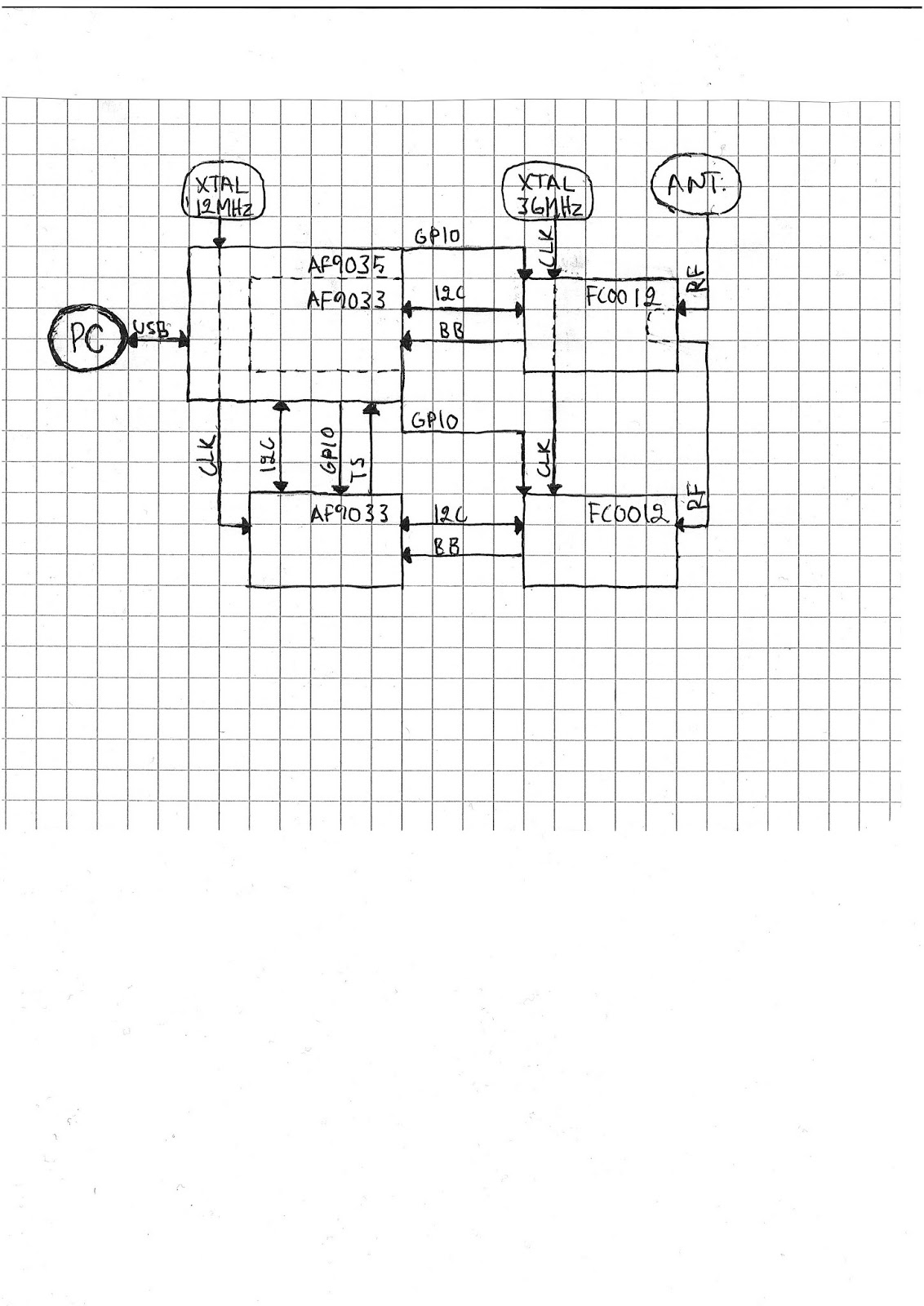 | |
| AF9035 FC0012 dual tuner block diagram |
It took something like 60 hours of work and result was only about 100 lines of code. Sometimes Kernel coding is very slow at the unit of used hours for lines of code, especially when hacking with complex embedded hardware.
USB interface
IDLE current drain without a driver: 183mA
Pictures


Subscribe to:
Posts (Atom)